
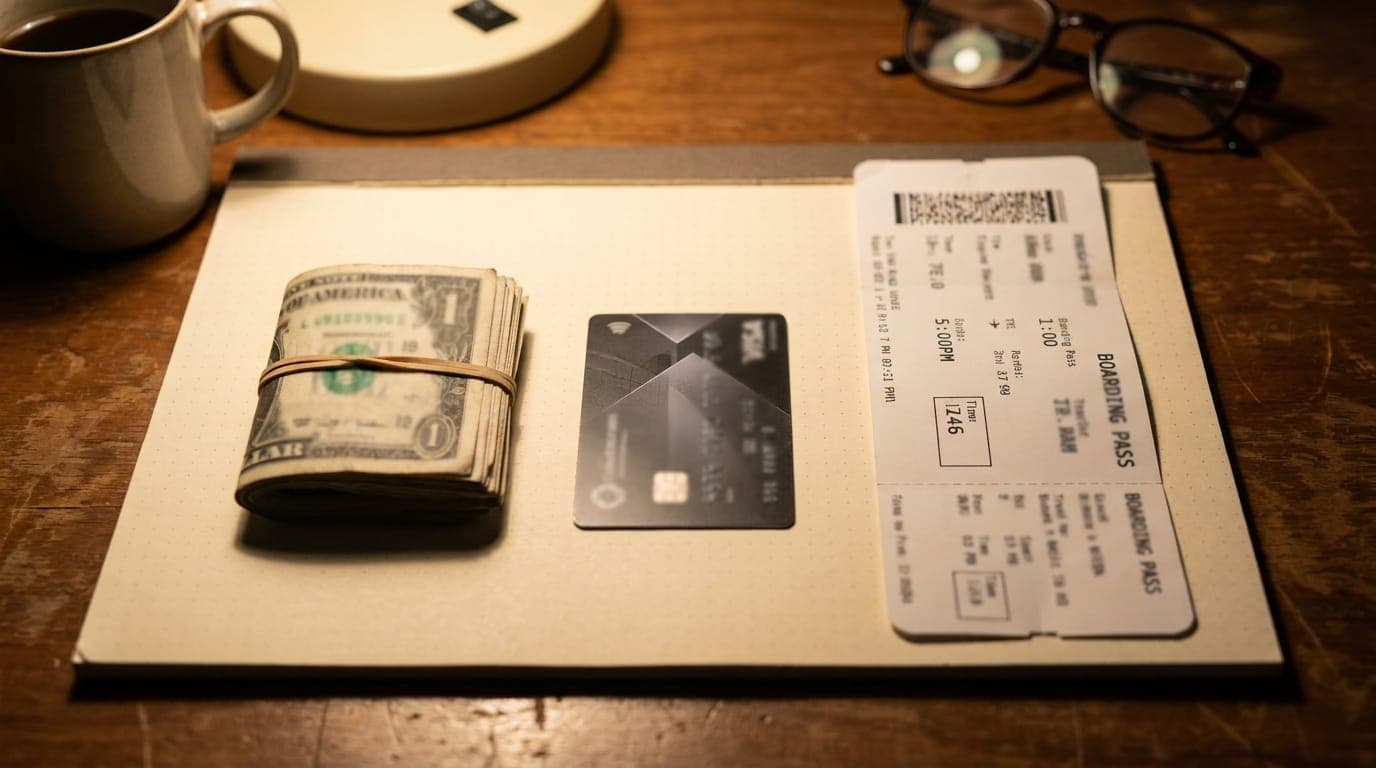
Fare talk in this industry is hypothetical. These three bookings are not: real routes, real booking windows, and the exact per-person prices we ticketed - including the expensive one, because that lesson is worth the most.
Every fare figure you read on travel sites - ours included - is a band: "typically $2,400-$2,900," "from $3,200." Bands are honest, but they are still abstractions. So we are starting a series that is not abstract at all: real bookings from our own desk, anonymized, with the route, the cabin, the booking window, and the exact per-person price as ticketed. No names, no record locators, no cherry-picking - Vol. 1 includes one booking that cost more than it needed to, because that file teaches the most.
File 1: A family of four to Italy for the holidays - $3,349 per person
Ticketed: September 3 · Departing: December 15 · Route: San Francisco to Rome non-stop on ITA Airways, an intra-Italy hop to Milan, returning Rome to San Francisco · Cabin: Business, four passengers · Total: $13,396.00, or $3,349 per person round-trip.
December 15 is peak holiday travel, and transatlantic Business for a family of four is exactly the booking most people assume is out of reach. Three things made this price happen. First, the 103-day booking window - deep contracted buckets were still open for mid-December when this family committed in early September. Second, ITA Airways: the A350 nonstop from the West Coast is one of the most aggressively priced Business products to Europe, a pattern our review has tracked all year. Third, the routing puts the intra-Italy Milan hop on the same ticket - protected connections, bags checked through, no separate booking to defend if a flight moves.
The comparable published-fare exercise is left to the reader on purpose: prices move daily and we only print what we can stand behind. What we can say is that four holiday-season Business seats at $3,349 each is exactly the price pattern behind our Business Class flights to Italy guide: ITA's contracted fares keep landing at the bottom of the transatlantic range.
File 2: Seattle to Bangalore, two travelers - $4,868 per person
Ticketed: July 29 · Departing: October 17 · Route: Seattle to Bangalore round-trip via Doha on Qatar Airways · Two passengers · Total: $9,736.00, or $4,868 per person round-trip.
There is no US non-stop to Bangalore from anywhere but San Francisco, so every Business Class trip to Bengaluru is a routing decision. This couple took the Doha one-stop: Qatar's Seattle departure connects cleanly to a short onward leg, and it was the routing that priced best of the options quoted on their dates. The 80-day window mattered here too - India tech-corridor routes hold their price unusually well because corporate demand never really stops, so the deepest buckets are the early ones.
The craft detail worth stealing: on two-ticket itineraries to secondary Indian cities, price the Gulf one-stops against a domestic add-on via Delhi or Mumbai before assuming the "obvious" routing wins. On these dates, Doha won. On other dates it loses. That is why every quote we send prices the alternatives side by side, in writing.
File 3: The expensive one - Minneapolis to Zagreb, 26 days out
Ticketed: July 29 · Departing: August 24 · Route: Minneapolis to Zagreb round-trip via Amsterdam, Delta and KLM · One passenger · Total: $6,823.03.
This is the file the fare bands warn you about. Booked inside the 30-day window, in August peak season, to a city with no US non-stop - three price multipliers stacked on one ticket. The contracted fare still did its job - a single-ticket AMS routing with lie-flat ocean crossings both ways - but no channel un-stacks those multipliers. But the honest lesson is the calendar, not the channel. The identical itinerary ticketed in May would have priced thousands lower.
If your trip is inside 30 days, the playbook changes: stay flexible on the connection city, consider last-minute deal inventory where saver buckets reopen 7-14 days out, and get the quote in writing the same day - short-window fares do not wait.
Why we publish these
Two reasons. First, transparency is the whole argument for booking through a consolidator desk: private fare classes sound like a trick until you see the transaction. Second, the industry's fare conversation runs on hypotheticals, and we hold real data - the same records that power our Business Class Fare Index, which tracks typical bands across 98 US routes and now updates on a dated monthly cycle.
Every number above is exactly as ticketed, taken from the booking record: route, cabin, passenger count, booking date, departure date, total charged. We anonymize the traveler, never the fare. If a future file makes us look slow or expensive, it runs anyway - Vol. 1 already includes the $6,823 ticket, and the series only works if it stays honest.
Frequently asked
Are the Booking Files real bookings?
Yes. Every file is a real, ticketed booking from the Business Class Travel desk, with the route, cabin, passenger count, booking window, and total price taken verbatim from the booking record. Traveler identities are removed; the numbers are not adjusted.
Why include a booking that cost $6,823?
Because it is the truest lesson in the set: booking premium cabins inside 30 days, in peak season, to a city with no non-stop stacks three price multipliers. A series that only showed bargains would be marketing; showing the expensive file is what makes the cheap ones believable.
How do I get fares like File 1?
The pattern behind the $3,349 Italy fare: book 3-4 months out, be open to strong-value carriers like ITA on the route, and keep connections on one ticket. A written quote on your exact dates is free and shows whether your route has a similar file in it.