
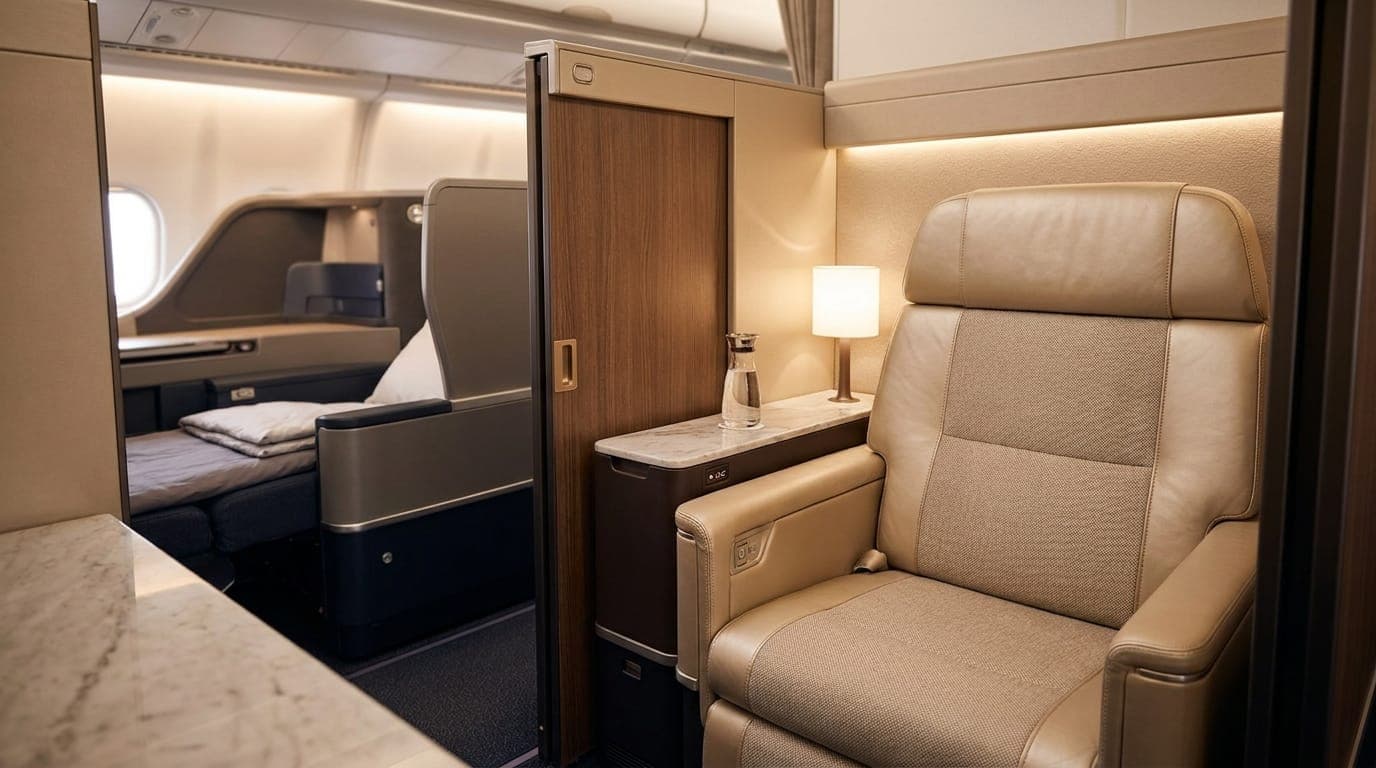
On modern long-haul aircraft, the gap between Business and First has compressed dramatically. Here’s what you’re actually buying when you pay 2-4× more.
A decade ago, the gap between Business Class and First Class was substantial. Business Class was a flat-bed seat with curtains; First Class was a private suite with a bed, a separate seat, and a bathroom you could turn around in. The hardware difference alone justified the 2-4× price premium for most travelers who could afford it.
The picture in 2026 is more complicated. Modern Business Class, Qatar Qsuite, Air France new-generation, BA Club Suite, Lufthansa Allegris, Delta One Suite, has closed roughly 70% of the hardware gap. The seats lie flat. The doors slide. The dining is multi-course. On many aircraft, the Business Class seat is wider than First Class seats from 2014.
“Modern Business Class has closed roughly 70% of the hardware gap to First. The remaining 30% is space, ground experience, and service density.”
What you’re actually paying for
So what are you still paying for in First Class? Three things primarily. The first is space, First Class suites are typically 30-50% larger than Business Class equivalents on the same aircraft, with separate seat and bed configurations. On Singapore Suites, Etihad First Apartment, Emirates First Suite, and Air France La Première, the seat and bed are separate fixtures; you have an armchair to sit in AND a bed to sleep in, not a single seat that converts.
The second is the ground experience. The headline First Class lounges, Lufthansa First Class Terminal at Frankfurt (a separate building, with a Mercedes drive to the aircraft), the Air France La Première lounge at CDG (with caviar service and à la carte dining), the Concorde Room at Heathrow T5, the Pier First Class at Hong Kong, the Qatar First Class Lounge at Doha, are unambiguously a step above Business Class lounges in the same airports. For travelers who arrive at the airport early or have long layovers, the lounge differential alone can justify a meaningful share of the fare gap.
The third is service density. First Class cabins typically have a 1:4 or 1:5 crew-to-passenger ratio versus 1:8 to 1:12 in Business Class. The dining is à la carte and on-demand rather than served in waves. Champagne is often a prestige cuvee, such as Dom Perignon on Emirates or Krug Grande Cuvee on Cathay Pacific, ANA and Singapore Airlines, rather than the non-vintage pours typical of Business Class. And on a small subset of First Class products, you get genuinely unique elements, the Onboard Shower Spa on Emirates A380 First, the bathroom-with-shower in Etihad’s Residence, the personal stylist closet on La Première.
Where Business Class wins
Where Business Class wins on price-per-experience: routes where First Class isn’t available (most US-based legacy carriers no longer sell First Class on transatlantic), routes where Business Class has a particularly strong product (Qatar Qsuite, Singapore A350 Business), and short-to-medium long-haul where the marginal benefit of First Class shrinks because the flight is shorter than a sleep cycle anyway.
Our advisors compare both cabins on every quote where First Class is sold. For 6–10 hour flights, Business Class on a strong product (Qsuite, Singapore Suites Class on A380, ANA The Room) often beats First Class on a weaker product. For 12+ hour flights, particularly transpacific to Asia or Sydney, First Class on Emirates, Singapore, ANA, or Lufthansa is a meaningfully different experience. We can quote both and let you decide.