
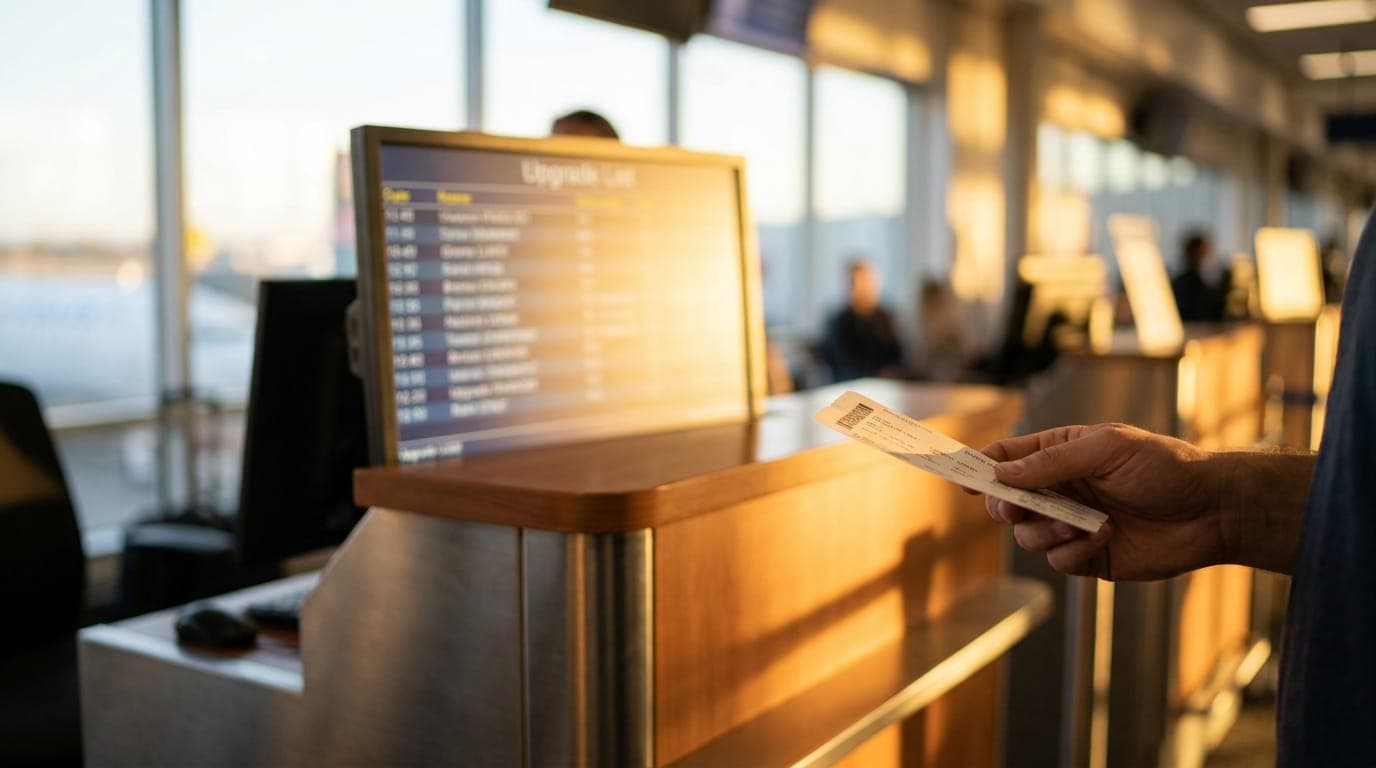
Free Business Class upgrades are mostly dead. Paid upgrade bids, miles + cash, and timing tactics are what actually work in 2026. Here's the realistic breakdown.
The blogosphere is full of "secret tips to upgrade to Business Class", wear a suit, ask at check-in, mention your honeymoon, look at the gate agent and smile. Most of this advice is from 2014, when operational upgrades (free upgrades when economy was oversold) still happened regularly. In 2026, that path is mostly closed.
What actually works in 2026 is **paid upgrades**, **miles + co-pay upgrades**, and **elite status upgrades**, in that order of cost-to-benefit. Below is the realistic breakdown of all seven upgrade strategies, what each costs, and the typical success rate.
1. Plusgrade bid upgrades, the new default
Most major airlines now sell unsold Business Class seats through Plusgrade or in-house bid platforms. You book economy, receive an email 7-30 days before departure with a bid range, name your price, and the airline accepts winning bids near departure based on cabin availability.
“Typical winning bids run 30-50% of the published Business Class fare differential. You only pay if your bid wins.”
When this works well: you booked a flexible economy ticket (refundable Y, B, M fare class) and have time flexibility. The catch: most "discount economy" fares (deep-discounted basic economy, V/N/Q class) are not Plusgrade-eligible. Check your fare class before bidding. Our upgrade bid strategy guide covers how much to offer and when a bid beats buying Business outright.
2. Miles + cash co-pay upgrades
Most frequent flyer programs let you upgrade economy tickets to Business Class with a mix of miles + cash co-pay. Typical 2026 rates one-way transatlantic:
- **American AAdvantage:** 25,000-50,000 miles + $250-650 co-pay (requires B/Y fare class)
- **Delta SkyMiles:** 30,000-50,000 miles + $200-500 co-pay (varies by fare class and route)
- **United MileagePlus:** 20,000-40,000 miles + $0-650 co-pay (PlusPoints system, GS-eligible)
- **BA Avios:** 50,000-90,000 Avios + $200-700 cash on long-haul
The math works if you have a large mileage balance and a refundable economy ticket. For one-way trips where the economy ticket is non-refundable, the cash component often makes a paid Business Class consolidator ticket cheaper.
3. Elite-status upgrades (system-wide upgrades)
Most major airline elite programs include some form of "complimentary upgrade" benefit, but on long-haul Business Class, these are almost always **System-Wide Upgrades (SWUs)** rather than automatic. You earn SWUs at top elite tiers (AA Executive Platinum, Delta Diamond, United Global Services) and apply them to specific tickets.
SWUs work when there's available Business inventory at the booking time you apply them. The top-tier elite frequent fliers grab most of them. Mid-tier status (AA Platinum, Delta Gold) is essentially useless for long-haul Business upgrades, you'll be waitlisted below all higher-tier members.
4. Booking the right fare class for guaranteed upgrade eligibility
Most upgrade methods (Plusgrade, miles + cash, SWUs) require a specific fare class. The general rule:
“Y, B, M class economy: usually upgradeable. Q, V, N, K class economy: usually not.”
When booking, ask for the fare class explicitly. A $1,400 "discount Y" economy ticket may be $300 more than the cheapest discounted economy fare, but if you can then upgrade it for 40,000 miles + $400, your total Business Class cost is $1,800 + miles versus $4,500 for direct Business, a meaningful win.
5. Gate-agent asks (the romantic but mostly-dead strategy)
The classic move: show up at the gate dressed nicely, smile at the agent, ask politely "is there any chance of an upgrade?" Success rate in 2026: roughly 5-10% on US carriers, 10-15% on international carriers. Works best when (1) you have any elite status with the airline, (2) the flight has empty Business seats (lightly-booked Tuesday/Wednesday overnight to a second-tier destination), and (3) you don't come across as entitled.
What doesn't work: mentioning your honeymoon, dropping that it's your birthday, telling sob stories, demanding upgrades. Agents have heard everything; they upgrade based on what their system allows, not on creative pleas.
6. Mistake-fare and award upgrade hacking
Two niche strategies. **Mistake fares** in Business Class show up 3-5 times a year, usually because a system error prices Business Class at $400-800 round-trip transatlantic. Follow Going (formerly Scott's Cheap Flights), Thrifty Traveler Premium, Premium Cabin Deals, and FlyerTalk for alerts.
**Award upgrade hacking:** booking partner-airline economy on a Star Alliance / Oneworld / SkyTeam award (e.g., book economy LHR-JFK on American with Avios) then upgrading separately. Complex and route-specific, but occasionally yields Business Class transatlantic for ~80,000 miles total.
7. Just book Business Class, through a consolidator
After working through the other six strategies, the realistic conclusion: the single most reliable, cheapest way to fly Business Class is to **book it directly through a contracted consolidator** at 30-60% off the airline's published Business Class fare. No bidding, no miles math, no gate-agent gamble, just a written quote for a confirmed Business Class seat.
Through our consolidator network, a JFK-LHR Business round-trip that retails for $4,800 on BA.com is regularly $2,400-2,900. That's less than the typical winning Plusgrade bid on top of a refundable economy ticket, and you get full Business benefits from check-in onward.
For a comparison of how consolidators stack up against each other, see our SkyLux Travel alternatives guide. For the full strategy guide on getting the lowest Business Class fares overall, see how to get cheap Business Class tickets.
The bottom line
If you have miles + a flexible economy fare class + time to bid: go through Plusgrade or miles + cash co-pay. If you have top-tier elite status: use SWUs. For everyone else, including most travelers planning vacation trips months in advance, booking through a consolidator beats every upgrade strategy on price and reliability.