
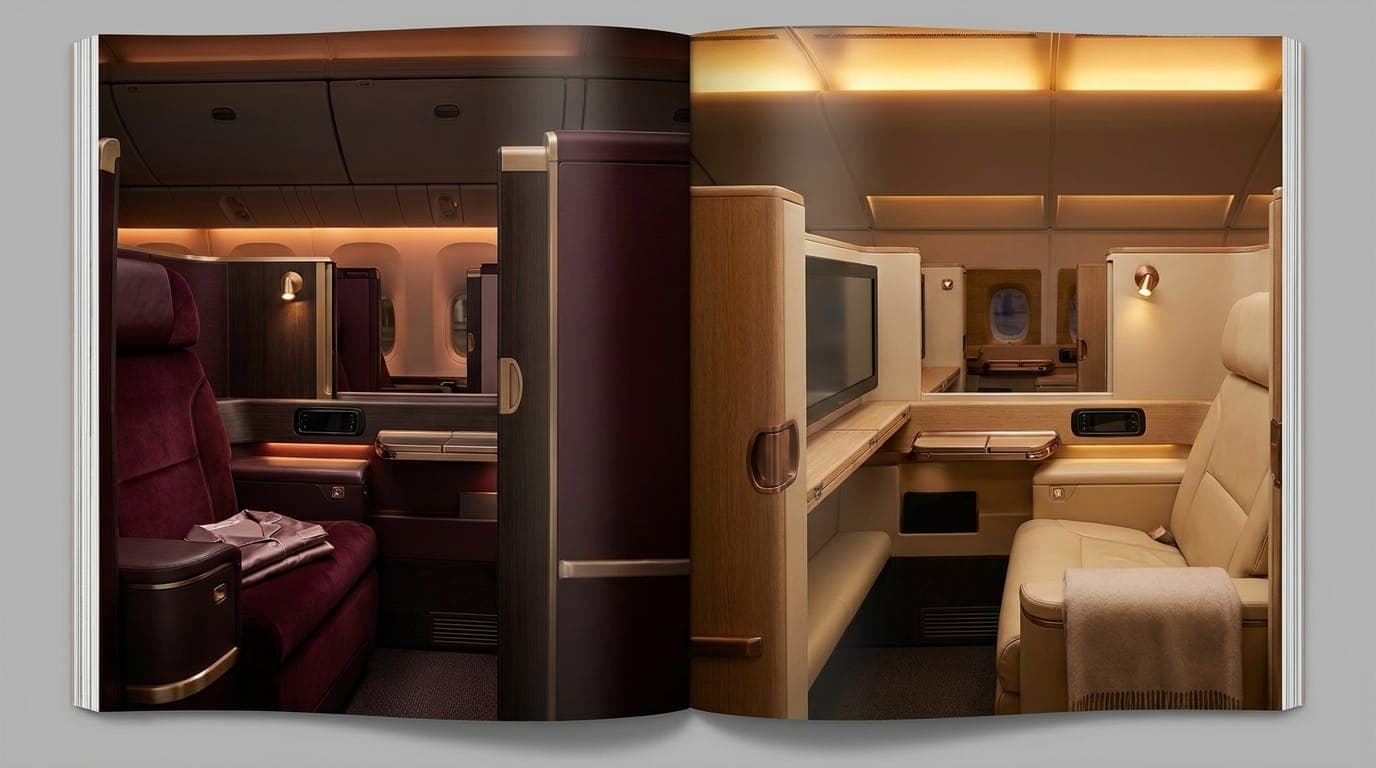
Two of the most-asked-about Business Class products in the world, compared on every dimension that actually matters: hard product, soft product, ground services, network, and what you actually pay through a consolidator.
Qatar Qsuite and Emirates A380 Business Class are the two most-asked-about Business Class products in the world. Both are operated by Middle Eastern carriers with deep US route networks. Both are routinely available through consolidators at 30%-60% below airline.com prices. And every traveler facing the choice asks the same question: which is actually better?
The honest answer is: it depends on what you value. This is the side-by-side, on every dimension that matters in 2026, written by people who book both products weekly for clients.
Hard product (the seat)
Qatar Qsuite is the most decorated Business Class hard product in the world. Each seat is a private suite with a closing door, 1-2-1 configuration on the A350-1000 and 777-300ER. Center suites convert into a Qsuite-Quad (four-seat private compartment, unique to Qatar) or a Qsuite-Double (two adjacent suites with center divider lowered into a double bed, the only true double-bed Business Class in commercial aviation). Bed length 79 inches, width 26 inches.
Emirates A380 Business Class is on the upper deck, 1-2-1 lie-flat with direct aisle access. Bed length up to about 79 inches (200 cm), seat width about 18.5 inches. No closing door. The cabin is dimmer and quieter than the 777, and the design language is theatrical without being cartoonish (burl wood, gold finishings). The 777 fleet is mixed: newest Game Changer 777-300ERs have 1-2-1 lie-flat (excellent), older 777-300ERs still have 2-3-2 angle-flat (avoid). Always verify the aircraft on an Emirates 777 booking.
Verdict: Qsuite wins on hard product, decisively. The closing door, the bigger bed, and the unique Qsuite-Quad/Double options have no Business Class equivalent.
Soft product (food, drink, service)
Both carriers serve dine-on-demand Business Class: you eat when you want, not when the cabin crew rolls the cart. Both have curated wine programs with at least one Champagne (Qatar rotates its Business pours; Emirates pours Veuve Clicquot or Moet & Chandon in Business depending on route, and Dom Perignon in First). Both have excellent caviar service on East-to-West routes.
Qatar Business Class food consistently rates higher in third-party reviews (Skytrax, The Points Guy, Live and Lets Fly) for plating, ingredient quality, and a la carte execution. Emirates wins on Arabic mezze and on dessert breadth.
Service: Qatar crew tend to be more formal and procedural; Emirates crew tend to be warmer and more personable. Neither is "better," but the styles differ. If you prefer to be left alone unless you signal, Qatar. If you prefer attentive engagement, Emirates.
Verdict: Qatar wins narrowly on food. Service preference is personal.
In-flight unique features
Emirates A380 has the Onboard Lounge: a social bar space at the rear of the upper deck, open throughout the flight, exclusive to Business and First passengers. Full bar (cocktails, Champagne, beer, spirits), small bites served continuously, standing/seating room for ~20 passengers at a time. This is genuinely unique in commercial aviation. On a 14-hour flight, the ability to walk to a bar and have a conversation with another passenger changes the experience.
Qatar Qsuite has no equivalent social space. The Qsuite-Quad / Double turns the seat itself into a more sociable space for couples and families, but there is nothing for solo travelers to walk to.
Verdict: Emirates wins. The Onboard Lounge is one of very few bars in Business Class (Qatar's A380 has one too, but not on US routes), and on flights over 10 hours it materially improves the journey.
Hub experience
Qatar Al Mourjan Business Lounge in Doha is the most-decorated Business Class lounge in the world. A la carte dining, multiple bars, a quiet zone, family rooms, full shower suites across two floors. It is also large enough that even at peak times it does not feel crowded.
Emirates Dubai Business Lounge spans the entire upper concourse of Terminal 3 Concourse B at DXB. Multiple bars and dining stations, direct boarding from the lounge level (no shuttle, no separate gate walk). Newer than Al Mourjan and less acclaimed for food, but the scale and the direct-to-aircraft convenience are real advantages on tight connections.
Verdict: Al Mourjan wins on lounge experience. Dubai Business Lounge wins on scale and connection convenience.
Network
From the US, Emirates serves more cities directly: Boston, Chicago, Dallas, Houston, JFK (multiple daily), LAX, Miami, Newark, Orlando, San Francisco, Seattle, and Washington Dulles. Qatar serves Atlanta, Boston, Chicago, Dallas, Houston, JFK, LAX, Miami, Philadelphia, San Francisco, Seattle, and Washington Dulles. Both publish onward connections via their respective hubs (DXB for Emirates, DOH for Qatar) to most major cities in Asia, Africa, Australia, and the Middle East.
For onward connections to Africa, Qatar Oneworld access via Royal Air Maroc plus partnerships with RwandAir and Air Seychelles gives Qatar slightly broader African coverage. For onward connections to Australia, both are competitive: Emirates partnership with Qantas runs through Dubai daily; Qatar partnership with Qantas runs through Doha daily.
Verdict: Effectively tied for the US-international primary leg. Slight edge to Qatar for African connections; slight edge to Emirates for Pacific reach via partnership.
Ground services
Emirates includes chauffeur drive on most US-originating Business and First Class tickets (the radius varies by city, commonly about 50 miles in the US; Business Special fares and awards exclude it), saving $100-300 per direction in transfer costs. The driver, vehicle (typically Mercedes-Benz S-Class), and timing are all coordinated by Emirates.
Qatar does not include chauffeur drive on standard Business tickets (only on First Class). Qatar Business does include priority check-in, priority security at most airports, and lounge access.
Verdict: Emirates wins. Chauffeur drive saves real money and removes airport-transfer logistics.
Pricing through a consolidator
Round-trip Business Class, US East Coast to hub:
- Emirates JFK-DXB A380 Business: typically $3,400-$4,000 in shoulder season, $4,800-$5,800 peak.
- Qatar JFK-DOH Qsuite: typically $3,200-$3,800 shoulder, $4,400-$5,200 peak.
For onward connections (e.g., Sydney, Bangkok, Cape Town), both carriers price competitively as add-ons in the $800-$1,400 range above the hub fare. Award redemptions: Qatar Qsuite via Oneworld partners (American, Alaska Atmos Rewards) starts at 70,000 miles one-way from the East Coast with low surcharges (~$50), when saver seats open. Emirates Skywards saver awards run ~110,000 miles + ~$700 surcharges (high YQ).
Verdict: Qatar runs ~5-15% below Emirates on equivalent US routes. For miles redemptions, Qatar via Oneworld is the substantially better value.
The honest summary
Buy Qatar Qsuite if you care most about the seat itself, want a closing-door suite, are traveling as a couple or family of four (the Qsuite-Quad is unmatched), or want maximum miles value via Oneworld partners.
Buy Emirates A380 Business if you care most about the in-flight social experience (the Onboard Lounge), want chauffeur drive included on both ends, value direct US-city coverage, or prefer warmer service style.
For most solo business travelers on a 12+ hour Doha or Dubai route, the choice comes down to the seat-vs-experience tradeoff. The right answer depends on whether you sleep through the flight (Qsuite) or stay up and want company (Emirates).
Frequently asked
Is Qatar Qsuite better than Emirates Business Class?
On the hard product alone, Qatar Qsuite wins: closing-door suite privacy and the unique Qsuite-Quad and double-bed configurations are unmatched in commercial Business Class. Emirates A380 Business wins on the in-flight social experience (the Onboard Lounge), on chauffeur drive in 70+ markets, and on cabin atmospherics. Net: Qsuite for the seat, Emirates for the journey.
How much does Qatar Qsuite cost vs Emirates Business Class?
Through a consolidator, JFK-DOH on Qsuite typically books at $3,200-$3,800 round-trip in shoulder season; JFK-DXB on Emirates A380 typically runs $3,400-$4,000. Published airline.com fares on both routes are typically 30%-60% higher. Onward connections from each hub (DOH for Qatar, DXB for Emirates) are usually competitively priced as add-ons.
Which has the better lounge: Qatar Al Mourjan or Emirates Dubai Business Lounge?
Qatar Al Mourjan in Doha is the most-decorated Business Class lounge in the world (multiple Skytrax wins): a la carte dining, a quiet zone, family rooms, and full shower suites across two floors. Emirates Dubai Business Lounge is enormous (the entire upper concourse of Terminal 3 Concourse B) with multiple bars, dining stations, and direct boarding from the lounge level. Al Mourjan wins on food and design; Dubai wins on scale and direct-to-aircraft convenience.
Does Qatar fly to more US cities than Emirates?
Emirates serves more US cities directly: Boston, Chicago, Dallas, Houston, JFK (multiple daily), LAX, Miami, Newark, Orlando, San Francisco, Seattle, and Washington Dulles. Qatar serves Atlanta, Boston, Chicago, Dallas, Houston, JFK, LAX, Miami, Philadelphia, San Francisco, Seattle, and Washington Dulles. Both have deep partner networks (Qatar via Oneworld, Emirates via Skywards and JetBlue/Alaska partnerships) for onward US connections.
Which is better for family travel: Qatar Qsuite or Emirates A380?
Qatar Qsuite for parents-with-kids: the Qsuite-Quad (four center seats convert to a shared private compartment) is unique among Business Class products and built for family groups. Emirates A380 for general family comfort: upper-deck Business is quieter, the Onboard Lounge gives kids a place to stretch, and chauffeur drive in 70+ markets removes the airport-transfer logistics on both ends.
Should I book Qatar or Emirates with miles?
Qatar Qsuite saver awards on Oneworld partners (American AAdvantage, Alaska Atmos Rewards) start at 70,000 miles or points one-way from the US East Coast with very low surcharges (~$50), though saver seats are limited. Emirates Skywards saver awards on Emirates metal run ~110,000 miles + ~$700 in surcharges one-way (high YQ). For miles value, Qatar via Oneworld is the better redemption. For miles flexibility, Emirates accepts transfers from Amex, Citi, Capital One, and Chase 1:1.